Showing posts with label Friend Grief and the Military. Show all posts

Monday, November 10, 2014

Friend Grief on Veterans Day

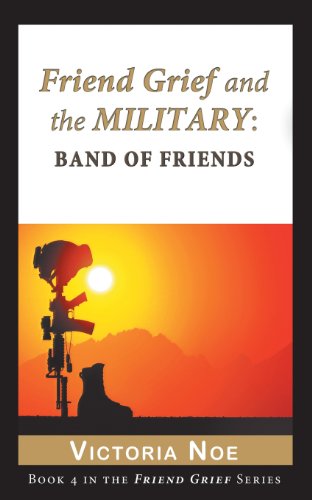
For Veterans Day, I'm reposting the announcement of my latest book, Friend Grief and the Military: Band of Friends. It recently earned an honorable mention in the Chicago Writers Association 2014 Book of the Year Awards. But what means even more to me are the reactions of veterans who have read it: "You get it."


Grief is hard. Grief for our friends is often dismissed as unimportant, at least when compared to losing a family member. But friendships forged in the military are different, very different. You’re friends, but more, because your lives depend on it.

In my book, you’ll meet men and women on the front lines who watched their friends die, and carry the trauma of that moment with them for decades. You’ll meet noncombatants – doctors, nurses, chaplains, war correspondents and even a little drummer boy from the Civil War – who struggle with grief and guilt and carrying on.

You’ll learn about moral injury, and how that may be a much bigger story than PTSD. And you’ll learn why the oft-recited statistic of 22 veterans a day committing suicide is shockingly inaccurate.

And because grief also changes people for the better, you’ll be introduced to individuals and organizations who are working with veterans to resolve their guilt, work through their grief and honor their fallen friends.

I struggled with the title. Everything I came up with was too vague or too wordy. So I explain in this excerpt how I made my decision:

The popular mini-series Band of Brothers took its title from what has become known as the St. Crispan’s Day speech in Shakespeare’s Henry V:

                        This story shall the good man teach his son;

                        And Crispin Crispian shall ne’er go by,

                        From this day to the ending of the world,

                        But we in it shall be remembered –

We few, we happy few, we band of brothers;

For he to-day that sheds his blood with me

Shall be my brother…


Since Shakespeare’s time we’ve often heard soldiers, sailors and Marines refer to their battle buddies as “brothers”. Even though it’s somewhat problematic, given the increasing role of women on the front lines, the designation has stuck.

In writings as far back as the ancient Greeks, the relationship between soldiers has been described as comparable to family. A family is a group of people related by blood that functions together with common goals and dependency. “Blood is thicker than water,” right?

In the military, nothing can be accomplished without the trust and dependability of those in the unit. That cohesiveness is the difference between success and failure, life and death, every hour of every day. The bond is stronger than a normal friendship because your lives depend on it. So, when asked why they refer to their friends as brothers, you are likely to get an answer along the lines of “because they mean as much to me as family.” Referring to other soldiers as family members is, from their perspective, the highest compliment.

A similar phenomenon existed in the AIDS community in the 80s and 90s. People with HIV/AIDS – gay, straight, young, old, male, female – were often abandoned by their families. Their friends became their family of choice – of necessity, really – because their lives depended on them.

Conventional wisdom still holds that the bond between family members is normally stronger than that between friends. But I wonder why, considering this quote that’s quite a bit older than Shakespeare’s:


“Greater love has no one than this: to lay down one's life for one's friends.” (John 15:13)


That’s why this book is not titled Band of Brothers or Band of Brothers and Sisters.


This book is titled Band of Friends.


Friend Grief in the Military: Band of Friends is now available for Kindle, Nook and Kobo; paperback version available from Amazon, Barnes & Noble and IndieBound.

Wednesday, October 29, 2014

The End of the Friend Grief Series?

Don’t get excited. It’s not happening tomorrow.


When I made the decision to serialize what was originally one book I knew it would eventually end. I believed there would be six books in the series. That’s still my assumption. What’s changed is the subject of the sixth one.

By now you know that I’ve published four books

            Friend Grief and Anger: When Your Friend Dies and No One Gives A Damn

            Friend Grief and AIDS: Thirty Years of Burying Our Friends

            Friend Grief and 9/11: The Forgotten Mourners

            Friend Grief and the Military: Band of Friends

The fifth book, Friend Grief in the Workplace: More Than an Empty Cubicle, comes out in January (details will be announced in mid-December).

I thought the sixth book would be a wrap-up. It would be just about people who made major life changes after their friend(s) died. But those stories can be found in the first five books. They’re not just stories about someone dying and how their friend coped. They’re about those friends and how they lived their lives afterwards. That sixth book, in effect, is spread among the first five. But instead of ending the series after five books, I realized I already had the beginnings of a sixth book.

In 2012, before I decided to serialize my original book idea, I wrote a guest post for The Good Men Project. It was my mea culpa for assuming that it would be near impossible to get men to talk about grieving their friends. As I said in the article, I’ve never been so wrong. I promised then to write a book on this very topic. And so I shall.

Before you ask why I have not considered writing a book just about women grieving their friends, read the post. Women are much more likely to share their grief – in fact, they’re expected to. Men? Not so much.

After sleeping on the idea for a few nights, I decided today that the sixth book in the series will indeed be about men grieving their friends. I don’t have a title yet; that usually comes while I’m working on the book. But I have some damn powerful interviews to share.

Who knows? There may be a seventh book or even an eighth. I’ve had intriguing suggestions for future titles, so we’ll see.

There you have it, then: the change of subject for the sixth book is my big news for now. Next week, you’ll hear about the anthology I’m proud to be part of, as well as more announcements about book signings.

As always, stay tuned!

Tuesday, August 5, 2014

“Oh, That’s Depressing” – Writing about Friend Grief

I wish I had a dollar for every time I’ve told someone what I write about. “Oh, that’s depressing” is certainly the most frequent negative response. Luckily, I don’t hear it too often.

I was in New York last week at the Writers Digest Conference. Going to this particular conference in January, 2011, was what really kick-started my writing career. I met people there (and shortly after) who are still trusted advisors and friends. I started tweeting on my way to the conference so I wasn’t the only one there who wasn’t on Twitter. This blog began a week later.

Although I haven’t been posting as regularly the past few months, it’s not because I had nothing to say. There were health issues that got in the way, and at times, the self-publication process took precedence. I will be blogging more religiously now, I swear. But I digress.

Writers are supposed to have an “elevator speech”: how do you describe your work in the time it takes for an elevator ride? It shouldn’t surprise you that the reaction varies greatly depending on whether I say “I write about grief” or “I write about friendship”.

If I say I write about grief, there’s always someone who considers that depressing. No, I insist, it’s not depressing. Some of the stories are sad, but they’re not depressing. They’re about the impact our friendships have on us. That usually appeases them, at least for the moment.

Then there are the people who do not have a negative reaction. “I write about people who are grieving the death of a friend.” I used to call it the “You know…” moment. I’d tell them what I write about and there would be a pause, Their eyes never left mine, but I could see a spark of recognition.

Sometimes they nod, sometimes they smile, but the message is always the same: “Yeah, I get that.” More often than not, they’d say “You know…” and tell me a story about a friend of theirs who died.

At the Writers Digest Conference, I spoke with two men: one a former Marine, the other a former Air Force pilot. When I told them I’d written a book about losing friends in the military, they both had the exact, same physical reaction: They straightened up a little more, eyes open a little wider, and nodding slightly they both said, “Yeah…”.

That, as we heard in the conference sessions, is what many writers dream of: making a personal connection to their readers. They don’t want to read something theoretical, something dry. They want to read something that speaks to their hearts: something they can identify with and understand.

It took me a while to accept that I was capable of writing something that appealed to people. The compliments still surprise me. Unlike the publisher’s rep who told me three years ago that “grief is only going to be big for another two years”, the rest of the world knows that there is no expiration date on a universal experience.

There is one thing that’s hard for me. When I’m done with my research, and I’m immersed in putting stories together for a book, there are times when I find myself overwhelmed. It was particularly true with the last book, Friend Grief and the Military: Band of Friends. Although the previous two books (AIDS and 9/11) were also about people who died under horrible circumstances, this one was different. For several weeks, I was grumpy, to put it mildly. I came out of it, and I believe in the end, the book shows not just the unique grief of those who lose friends in war, but how the survivors are able to process their grief, sometimes in very creative ways.

Depressing? Maybe.

Sad? Definitely.

Inspiring? Very much so.

The reactions of my readers – and future readers – here on the blog, on Facebook, Pinterest, LinkedIn, Twitter, Google+, in much-appreciated reviews on Amazon and Goodreads, in private messages and in person – are what keep me going. So keep them coming! And thanks for being part of Friend Grief.

Friday, June 6, 2014

Friend Grief in New York - Part 2

Book #4 in the New Title Showcase
This post is a bit of a departure from normal posts. It’s a look at what Friend Grief – the blog and the books (the brand, if you will) – was doing at Book Expo America.

I’ve attended BEA before (so I wore comfortable shoes and allocated time for standing in the Starbucks line), but this year was different. I had a very specific purpose for being there and the first ever Author Hub gave me the opportunity to take a big step forward.

The Author Hub was a dedicated area for self-published authors. Over the course of three days, we heard speakers address a variety of business topics (marketing, rights, agents, discoverability). We had room to conduct meetings, meet with other authors, promote our books, read from them and meet eager readers.

My plan for this year was to expand my team. I already have an editor, cover designer and formatter. I went to BEA looking for someone to handle publicity and a website designer. I went there to discuss international and translation rights, as well as determine how best to reach out to libraries.

I’ve exhibited at conferences and conventions before, so when people ask me “how did it go?” my answer is as always: “I don’t know yet.” Yes, some deals are struck on the convention floor. But not all business decisions can or should be made that quickly.

In the short term, though, I accomplished enough to be satisfied:

  1. My new book, Friend Grief and the Military: Band of Friends, got exposure in the New Title Showcase and catalog, and I did a brief reading from it in the Author Hub.
  2. I signed with IPR License, which will handle international and translation rights, as well as large print, audio, serialization rights. I may have them handle permissions as well, so if anyone wants to quote from my books, I can direct them to IPR.
  3. I met with two candidates for publicist and am awaiting proposals from them.
  4. I signed with a new program that will curate and promote self-published e-books to libraries.
  5. I spoke on a panel at uPublishU about building your author platform.
  6. I was offered a speaking engagement.
  7. I found several new outlets for discoverability.
  8. And I turned down the opportunity to work with companies that were either not a good fit or sounded iffy.

There are more things in very early stages that I don’t want to jinx, and a few opportunities that I’ve filed away for future reference. I have a lot of follow-up to do: thank you’s, requests for more information, inquiries. But you’ll notice one glaring omission: I didn’t mention publishers.

Unlike some self-published authors, I did not go there to catch the eye of a traditional publisher. I’m happy doing things the way I’m doing them (despite my lack of patience with the process at times).

Hugh Howey in the Author Hub
As much as the internet has revolutionized publishing and marketing, there is simply no substitute for face time. At BEA you have the opportunity to meet people you’ve only known online (like Shirley Showalter and Orna Ross). You have the chance to see how people interact. That’s a big thing for me: watching people in action gives me a sense of how we might work together. All the while I kept in mind what an agent once told me, “It’s harder to say no to someone you’ve met.”

My disappointments with BEA are relatively minor (like noise level in the Hub, which couldn’t be helped). I was so busy I didn’t get to all the exhibits or educational sessions I wanted to attend. My deepest disappointment is being so busy I didn’t realize Benedict Cumberbatch was there until it was too late.

The important thing is that the Friend Grief series now has a higher visibility. More people will be able to learn about the books and find them easily because of my work at BEA.

My thanks go out to Porter Anderson and BEA for putting together the inaugural edition of Author Hub. I look forward to an even better experience next year.

Monday, May 26, 2014

Friend Grief and the Military

It’s Memorial Day, the day we remember those who gave the ultimate sacrifice to preserve our freedom. It’s also the launch day for the fourth book in my series, Friend Grief and the Military: Band of Friends.

Grief is hard. Grief for our friends is often dismissed as unimportant, at least when compared to losing a family member. But friendships forged in the military are different, very different. You’re friends, but more, because your lives depend on it.

In my book, you’ll meet men and women on the front lines who watched their friends die, and carry the trauma of that moment with them for decades. You’ll meet noncombatants – doctors, nurses, chaplains, war correspondents and even a little drummer boy from the Civil War – who struggle with grief and guilt and carrying on.

You’ll learn about moral injury, and how that may be a much bigger story than PTSD. And you’ll learn why the oft-recited statistic of 22 veterans a day committing suicide is shockingly inaccurate.

And because grief also changes people for the better, you’ll be introduced to individuals and organizations who are working with veterans to resolve their guilt, work through their grief and honor their fallen friends.

I struggled with the title. Everything I came up with was too vague or too wordy. So I explain in this excerpt how I made my decision:

The popular mini-series Band of Brothers took its title from what has become known as the St. Crispan’s Day speech in Shakespeare’s Henry V:

                        This story shall the good man teach his son;

                        And Crispin Crispian shall ne’er go by,

                        From this day to the ending of the world,

                        But we in it shall be remembered –

We few, we happy few, we band of brothers;

For he to-day that sheds his blood with me

Shall be my brother…


Since Shakespeare’s time we’ve often heard soldiers, sailors and Marines refer to their battle buddies as “brothers”. Even though it’s somewhat problematic, given the increasing role of women on the front lines, the designation has stuck.

In writings as far back as the ancient Greeks, the relationship between soldiers has been described as comparable to family. A family is a group of people related by blood that functions together with common goals and dependency. “Blood is thicker than water,” right?

In the military, nothing can be accomplished without the trust and dependability of those in the unit. That cohesiveness is the difference between success and failure, life and death, every hour of every day. The bond is stronger than a normal friendship because your lives depend on it. So, when asked why they refer to their friends as brothers, you are likely to get an answer along the lines of “because they mean as much to me as family.” Referring to other soldiers as family members is, from their perspective, the highest compliment.

A similar phenomenon existed in the AIDS community in the 80s and 90s. People with HIV/AIDS – gay, straight, young, old, male, female – were often abandoned by their families. Their friends became their family of choice – of necessity, really – because their lives depended on them.

Conventional wisdom still holds that the bond between family members is normally stronger than that between friends. But I wonder why, considering this quote that’s quite a bit older than Shakespeare’s:


“Greater love has no one than this: to lay down one's life for one's friends.” (John 15:13)


That’s why this book is not titled Band of Brothers or Band of Brothers and Sisters.


This book is titled Band of Friends.


Friend Grief in the Military: Band of Friends is now available for Kindle, Nook and Kobo; paperback version coming soon.

Friday, May 16, 2014

News from Friend Grief

I’m heading into a very busy few weeks – all good! 


If you’re in New York or Chicago, here’s what’s on the calendar:


May 29-31 - Book Expo America, Jacob Javits Center, NYC

I’ll be in the new Author Hub, showcasing a small group of self-published authors. If you’re attending BEA, including Saturday’s Book Con for the general public, please stop by and say hi!

My new book, Friend Grief and the Military: Band of Friends is featured in the New Title Showcase.

May 31 - uPublishU, Jacob Javits Center, NYC

The final day of Book Expo America includes a self-publishing conference, uPublishU. I’m excited to be the only author on the panel “Build Your Author Platform and Publish Successfully”.

June 1 - Bureau of General Services – Queer Division, 83A Hester St., NYC

I’ll be talking and signing the updated edition of my second book, Friend Grief and AIDS: Thirty Years of Burying Our Friends at 7:00pm at this great indie bookstore.

June 7 - Printers Row Lit Fest, Chicago, IL

From 10-2, I’ll be in the Chicago Writers Association tent signing all four of my books. When you purchase Friend Grief and AIDS, Friend Grief and 9/11 and/or Friend Grief and the Military you’ll get a free copy of Friend Grief and Anger: When Your Friend Dies and No One Gives A Damn.

June 14 - Logan Square Public Library, Chicago, IL

I’ll be with a great group of local authors for the “Chicagoland Authors Promoting Success Expo” from 2-4:30. Stop by to hear a very diverse group of writers talk about their work.

Next week here on Friend Grief, you’ll meet some of the terrific people in my new book Friend Grief and The Military: Band of Friends. They’re doing great work to help our veterans.

Stay tuned!

Tuesday, April 22, 2014

Coming Soon from Friend Grief

It’s very busy in my house: spring cleaning, office reorganization and the next book in the Friend Grief series about to be published. So I thought this is a good time to let you know what’s coming in the next couple months:

I’ll be in the first AuthorHub at Book Expo America, May 29-31. It’s a special area for self-published authors, and includes such superstars as Hugh Howey. (I’m definitely not in his league, but it’s nice to bask in the glow.) If you’re attending, please stop by and say hi!

Here on Friend Grief during May, leading up to the next book’s publication, I’ll have a series of posts on people and organizations I’ve met during the research, including Stop Soldier Suicide, American Women Veterans and the National Veterans Art Museum. My hope is that you, too, will be motivated to help them and their cause in whatever way you can.

I’ll also be guest blogging on a number of sites next month, and I’ll share those links with you soon.

Like my books on AIDS and 9/11, there’s a wealth of information out there for people in the military: books, films, organizations doing important work that helps those who have lost a friend in battle. Some are listed in the book, but more will be available here and on my Pinterest page.

In June, I’ll be signing at Printers Row Lit Fest and Chicagoland Authors Promoting Success. If you’re in Chicago either of those weekends, I hope you’ll stop by and meet some terrific writers.

July 1st I’m launching my first email newsletter for my readers. Sign-up info coming soon!

Lastly, and most important, Friend Grief and the Military: Band of Friends will be released on Memorial Day. It will be available, of course, in paperback and e-book. You’ll be able to find it on IndieBound, Amazon, Barnes & Noble, Kobo and iBookstore. I’m pleased to share this synopsis (the cover design will be revealed soon):

“They were killing my friends.”

That was how Medal of Honor winner Audie Murphy justified his heroic actions in World War II. As long as there have been wars, men and women in the military have watched their friends die. Experts warn that delaying our grief will complicate our lives. But what about those who have no choice but to delay it until the battle is over?

In Friend Grief and The Military: Band of Friends you’ll meet military and non-combatants who struggle with the grief and guilt of losing their friends. You’ll learn, too, in the amazing ways they help each other, that “leave no one behind” is a life-long commitment.

Like they say, stay tuned. There is more excitement in the works that I can’t wait to share with you!