Thursday, December 4, 2014

"All My Friends Are Dead"

Pierre on "Combat"
Growing up in the 60s, I was, along with my friends, definitely anti-war. I knew guys who served in Vietnam – two who died – but I didn’t agree with the war. 

It seemed odd to many that one of our favorite TV shows was Combat! It ran from 1962-67, and featured a squad of American soldiers in France after the D-Day invasion. We watched the show because we thought the actors were cute. And my favorite was Pierre Jalbert.

Pierre was my “type”: under six feet tall, dark, lean. The French accent didn’t hurt. It was a great, long-distance fantasy…until we met.

The night we met
It’s a long story that I won’t get into, but one night in 1984, I think, my two best friends and I found ourselves partying with Pierre, his wife, and Jack Hogan, who played Kirby on the show. The next day I had the worst hangover of my life, but it was worth it. I only saw him once more, about a year after that. One of my friends kept in close contact, but I didn’t. I’m not sure why.

Pierre’s life was nothing short of amazing: Canadian ski champion, Olympic captain, friend of movie stars, ski instructor, sound editor, actor, writer. He built his house in Beverly Glen and was a talented wood carver. He was obsessed with the life of the Marquis de Lafayette. “He was 19 when he fought in the Revolutionary War!” he’d tell me again and again.

He told me because I visited him a few times in recent years to record the stories of his life. We’d sit in the dining room of his beautiful home, scanning old photos, taping our conversations.

During one of my visits
He was certainly frail those last years, after suffering a stroke. I drove him to some doctor appointments. Though he was frustrated with minor memory lapses, he never lost his sense of humor. Once, when a medical technician assumed I was his wife, he insisted, “No, she’s my girlfriend, not my wife.” I turned bright red, because even at 88, he was still a handsome flirt.

I wrote last week that I learned a lot from him in his last year. I didn’t just learn about Lafayette, or why he was brought in to help with The Godfather (Pierre’s responsible for the iconic baptism/mob hit sequence at the end of the movie).

I learned that he gave full credit to his friends for everything that happened to him in his life. A new one would appear at a crucial moment, offering him an opportunity that would change his life: the actress who invited him to Paris, the businessman who sponsored his immigration to the US. “I wouldn’t be where I am today without my friends.”

I learned that he missed them terribly. “All my friends are dead,” he insisted, when we first sat down to record his stories. “Not all of us,” I countered. His stories about his friends were told without a trace of envy or disapproval. He loved them for who they were, and though he didn’t always understand or condone their behavior, he loved them nonetheless.

I learned that with every setback – rheumatic fever, the shattered leg that left him in constant pain for over 60 years, deportation when he failed to secure a work visa – he bounced back. He had a resilience that was remarkable. “Weren’t you depressed when you couldn’t ski in the Olympics?” “Sure,” he agreed. “For a week.” Then, Norma Shearer invited him to Paris, and he moved on to the next adventure.

I learned that it’s possible to live your life without regrets. When he insisted he had no regrets about his life, I was skeptical. I tried to bait him, frankly. Maybe it was Buddhism that gave him that peace. But just as he saw his friends impact his life, he saw each twist and turn as something ultimately better. Everything happened for a reason.

I feel like I learned a lot from Pierre. I still have my notes and my tapes. Next year I’ll transcribe them and put them into a coherent tale about one of the most remarkable men I’ve ever known.

I can hear his voice sometimes. If I close my eyes I can feel his hand in mine as we walked through the parking lot to lunch. When my car windshield is dirty, I think of him insisting I pull into the gas station in Santa Monica so he could clean it.

Finally, Pierre, I’m writing about you. Don’t give me that typically French shrug, as if you don’t care. I know better. So wherever you are, pour yourself a scotch on the rocks and settle back.

Allons-y.

Monday, December 1, 2014

World AIDS Day 2014

Today, December 1, is the 27th annual observance of World AIDS Day.

Since that first year, when I dropped a few pounds in the collection can at the curtain call of a play in London, I’ve marked the anniversary.

The second year I coordinated a fundraising event. Some years I went to a special Mass or memorial service. Other years I simply made note of it and went about my business.

This year I’ll be part of a reading and panel discussion at Women & Children First bookstore in Chicago about the generation gap in the AIDS community. This reflection on Huffington Post last week will give you an idea of what that means in terms of fighting the epidemic.

The theme for World AIDS Day this year is “Focus, Partner, Achieve”.

This year the epidemic looks like this:

            1.2 million people in the US are living with HIV; 14% don’t know they’re infected.

            The annual number of new infections has held steady for 10 years: 50,000/year.

            13,000 people with AIDS in the US will die this year.

The African-American community – particularly men who have sex with men – is disproportionately affected.


So, how do we follow the theme for this year?


Focus:              Target education and prevention efforts to the communities most at risk: African-Americans and young people 13-24

Partner:            Work with faith communities, schools, government agencies and nonprofit organizations to reach those communities.

Achieve:          Make an AIDS-free generation our goal.


What does all that mean?

It means that 30+ years into the epidemic, there’s a hell of a lot of work to do, in the US and around the world.

It means we have to reach out to make sure that every conversation- whether it’s about education, affordable housing, access to healthcare, affordable medications, anti-discrimination laws, aging – includes a recognition of how those issues impact people living with HIV, and those at risk of infection.

There is no cure. There is no vaccine. But unlike the early days, we have powerful tools: scientific knowledge, antiretroviral drugs, PReP (Truvada, which can effectively protect against infection).

That’s where reaching out to partner with others is important. The drugs won’t help you if you don’t know about them. They won’t help if you can’t afford them. It’s hard to keep to a regimen if you’re living in a homeless shelter. Unpredictable health won’t help you keep a job.

We’ve come a long way in 30+ years, but there is such a long way to go.

And I for one would like to see a day when, on December 1, people have to be reminded of what the world was like before AIDS was eradicated.

And the only way we do that is by working together, every day.


For more information on HIV, AIDS and what you can do to help:


Tuesday, November 25, 2014

Thankful for Our Friends – Here and Gone

The holidays are a difficult time for those who grieve.

Even under normal circumstances, we feel obligated to be happy, to enjoy ourselves, to crave the company of others. But for those who have suffered the loss of a friend, it’s tough to get in the holiday spirit.

We often hear that this time of year is for family. I think we all agree that we like to reconnect with friends, as well. I look forward to seeing friends from high school – often the only time all year we can sit together in one place and catch up on our lives. Next year we’ll have a reunion, but since we lost a classmate on 9/11, we don’t wait around for the next formal gathering. We no longer say “we should get together more often”. We do it.

A couple of my friends have faced serious health issues this year. Even though none of the situations turned out to be life-threatening, each one reminded me that none of us will live forever.

I’ve found myself being more assertive about making plans to get together with friends I haven’t seen in a long time – years, even decades. Those friendships have felt more intense this year. Maybe it’s our age. But there’s certainly a need to connect.

A friend of mine died in January. He was 89 and frail, so it wasn’t unexpected. I assumed I’d blog about him soon after. But I couldn’t. I tried, but I couldn’t. So now it’s ten months later – where did the year go? – and I still haven’t written about him.

It’s not that I forgot. Like my friend Delle, there are times I feel his presence, hear his voice. Things pop up that remind me of him. He doesn’t feel all that far away.

So next week, after I’m done with my World AIDS Day event in Chicago, I’m going to sit down and write about him. He taught me a lot during his last year that I’m still processing, so maybe this will help.

As you prepare to travel over-the-river-and-through-the-woods to celebrate Thanksgiving with your families, I hope you carve out (sorry, couldn’t resist that) some time for your friends as well – the ones who are here and the ones who are gone.

Give thanks for the friends in your life who made you who you are today.

If they’re still here, tell them how much they mean to you.

And if they’re not, tell them, too.

Monday, November 10, 2014

Friend Grief on Veterans Day

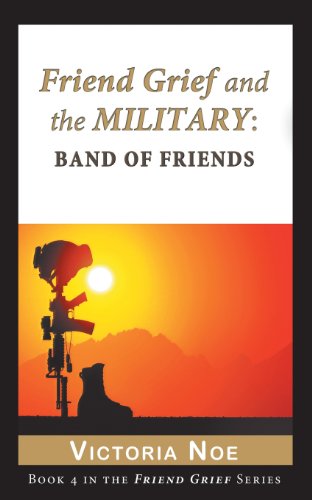
For Veterans Day, I'm reposting the announcement of my latest book, Friend Grief and the Military: Band of Friends. It recently earned an honorable mention in the Chicago Writers Association 2014 Book of the Year Awards. But what means even more to me are the reactions of veterans who have read it: "You get it."


Grief is hard. Grief for our friends is often dismissed as unimportant, at least when compared to losing a family member. But friendships forged in the military are different, very different. You’re friends, but more, because your lives depend on it.

In my book, you’ll meet men and women on the front lines who watched their friends die, and carry the trauma of that moment with them for decades. You’ll meet noncombatants – doctors, nurses, chaplains, war correspondents and even a little drummer boy from the Civil War – who struggle with grief and guilt and carrying on.

You’ll learn about moral injury, and how that may be a much bigger story than PTSD. And you’ll learn why the oft-recited statistic of 22 veterans a day committing suicide is shockingly inaccurate.

And because grief also changes people for the better, you’ll be introduced to individuals and organizations who are working with veterans to resolve their guilt, work through their grief and honor their fallen friends.

I struggled with the title. Everything I came up with was too vague or too wordy. So I explain in this excerpt how I made my decision:

The popular mini-series Band of Brothers took its title from what has become known as the St. Crispan’s Day speech in Shakespeare’s Henry V:

                        This story shall the good man teach his son;

                        And Crispin Crispian shall ne’er go by,

                        From this day to the ending of the world,

                        But we in it shall be remembered –

We few, we happy few, we band of brothers;

For he to-day that sheds his blood with me

Shall be my brother…


Since Shakespeare’s time we’ve often heard soldiers, sailors and Marines refer to their battle buddies as “brothers”. Even though it’s somewhat problematic, given the increasing role of women on the front lines, the designation has stuck.

In writings as far back as the ancient Greeks, the relationship between soldiers has been described as comparable to family. A family is a group of people related by blood that functions together with common goals and dependency. “Blood is thicker than water,” right?

In the military, nothing can be accomplished without the trust and dependability of those in the unit. That cohesiveness is the difference between success and failure, life and death, every hour of every day. The bond is stronger than a normal friendship because your lives depend on it. So, when asked why they refer to their friends as brothers, you are likely to get an answer along the lines of “because they mean as much to me as family.” Referring to other soldiers as family members is, from their perspective, the highest compliment.

A similar phenomenon existed in the AIDS community in the 80s and 90s. People with HIV/AIDS – gay, straight, young, old, male, female – were often abandoned by their families. Their friends became their family of choice – of necessity, really – because their lives depended on them.

Conventional wisdom still holds that the bond between family members is normally stronger than that between friends. But I wonder why, considering this quote that’s quite a bit older than Shakespeare’s:


“Greater love has no one than this: to lay down one's life for one's friends.” (John 15:13)


That’s why this book is not titled Band of Brothers or Band of Brothers and Sisters.


This book is titled Band of Friends.


Friend Grief in the Military: Band of Friends is now available for Kindle, Nook and Kobo; paperback version available from Amazon, Barnes & Noble and IndieBound.

Friday, November 7, 2014

Keeping in Touch with a Friend Who Died

Delle Chatman
I was helping my mother sort through old papers yesterday morning: bank statements, tax returns, paid bills. The shredder simply stopped twice, overheated and tired. On one of its breaks, I picked up two envelopes addressed to her in my handwriting. Puzzled, I opened them both to find copies of emails I had shared with my parents: emails from my friend, Delle Chatman.

When I realized what they were, I had to smile. You see, today is eight years since Delle died. I’ve felt her presence on occasion – so strongly at times I’ve heard her voice and once even felt her arms around me. My first thought upon seeing the emails was, “Gee, you’ve been quiet for a while. Where have you been?”

Those of you who have read my books or this blog for a while will recognize the name. Delle is the reason I’m a writer. I told her when she was in remission from ovarian cancer that I wanted to write a book about people who are grieving the death of a friend. She was enthusiastic about the idea, and made me promise to do it. It took a while, but I did.

The first email was dated New Year’s Eve, 2004. I won’t go into detail about it. It was deeply personal, reflecting on both her cancer battle and that of my father. She closed it saying she wanted us to get together the following week for coffee because she wanted some guidance from me on a new project.

I’m struggling to remember that project. It might be one of several; she always had something percolating. But I was a little surprised to see in print that she had asked for my help. I know we’d ask each other for input on various things, whether related to our daughters or our work. But still, it gave me a little comfort to see confirmation of her respect for my opinion.

The second email was dated Feb. 18, 2005, exactly four months before my father’s death. Delle, herself, was just out of the hospital after another recurrence of what she called “the beast”. While the first email was only for me, this one was sent to “Delle’s Elves”, those of us who had rallied around her since her initial diagnosis in 2002. It was one of her occasional emails bringing us up to date on her condition, outlook and needs.

As usual, she cut to the chase and related the bad news first. But most of the three page email was devoted to good news, exciting projects and her love of her daughter, The Remarkable Ramona. And she ended it as only Delle could: giving hope to those who sought only to hold her up:

I just wanted to let you all know there’s fresh cause to give thanks and to praise God. I wanted to share the depths of it all with you because for a few years now for some of you (thank Heaven for new friends!) you’ve walked with me in spirit, truth and love. I’m grateful for your company and your friendship.

This is what matters.

This is all that matters.

As you pray for me and Ramona, know that we are praying for each of you.

God has given us to each other.

And I, for one, am very, very glad about that.

Peace,

Delle


Like I said, I’ve “heard” from her many times since her death. Whether it was a candle flame sparking a fire on the side altar at our church during a Mass being said for her, or the sun blinding me through a stained glass window during my daughter’s confirmation (Delle was supposed to be her sponsor), each occurrence has been marked by a certain…theatricality. That’s how I know it’s her. Nothing subtle will do.

“God has given us to each other.”

I know all of Delle’s friends feel that way.

And we always will.

Monday, November 3, 2014

Friend Grief and the Holidays

Now that we’re past Halloween, the holidays are upon us. You may not be ready, but they’re coming anyway. For the first time in a long time, I will have my Christmas shopping done before Thanksgiving. But that was a self-defense decision, as I have an unusual amount of holiday commitments this year.

This may be a year in which you’ve lost a friend – or more than one. We tend to think of grieving during the holidays in the context of losing a family member. That’s often the case. It’s been forty years since my uncle died in a car accident less than two weeks before Christmas. There was not much to celebrate that year. Even when a death occurs much earlier in the year, the holidays become one of those ‘firsts’ we struggle to get through.

But little attention is paid to those who are missing a friend during the holidays. That grief is every bit as important. It’s just too often dismissed.

That’s why this Wednesday, Nov. 5, I’ll be the guest on a Google+ hangout on that very topic.

CHANGES, hosted by Sally Ember, will be live from 10-11am EST. You can be a part of it or check it out afterwards, if the time conflicts with your schedule.

Here are the links:

Wednesday, November 5 - , LIVE:

            Or catch our conversation any time on YouTube:

I hope to see you there with lots of questions for us! If you can’t make it, but would like to have your question answered, email me at victorianoe@friendgrief.com, and I’ll do my best to include it in our discussion.


Wednesday, October 29, 2014

The End of the Friend Grief Series?

Don’t get excited. It’s not happening tomorrow.


When I made the decision to serialize what was originally one book I knew it would eventually end. I believed there would be six books in the series. That’s still my assumption. What’s changed is the subject of the sixth one.

By now you know that I’ve published four books

            Friend Grief and Anger: When Your Friend Dies and No One Gives A Damn

            Friend Grief and AIDS: Thirty Years of Burying Our Friends

            Friend Grief and 9/11: The Forgotten Mourners

            Friend Grief and the Military: Band of Friends

The fifth book, Friend Grief in the Workplace: More Than an Empty Cubicle, comes out in January (details will be announced in mid-December).

I thought the sixth book would be a wrap-up. It would be just about people who made major life changes after their friend(s) died. But those stories can be found in the first five books. They’re not just stories about someone dying and how their friend coped. They’re about those friends and how they lived their lives afterwards. That sixth book, in effect, is spread among the first five. But instead of ending the series after five books, I realized I already had the beginnings of a sixth book.

In 2012, before I decided to serialize my original book idea, I wrote a guest post for The Good Men Project. It was my mea culpa for assuming that it would be near impossible to get men to talk about grieving their friends. As I said in the article, I’ve never been so wrong. I promised then to write a book on this very topic. And so I shall.

Before you ask why I have not considered writing a book just about women grieving their friends, read the post. Women are much more likely to share their grief – in fact, they’re expected to. Men? Not so much.

After sleeping on the idea for a few nights, I decided today that the sixth book in the series will indeed be about men grieving their friends. I don’t have a title yet; that usually comes while I’m working on the book. But I have some damn powerful interviews to share.

Who knows? There may be a seventh book or even an eighth. I’ve had intriguing suggestions for future titles, so we’ll see.

There you have it, then: the change of subject for the sixth book is my big news for now. Next week, you’ll hear about the anthology I’m proud to be part of, as well as more announcements about book signings.

As always, stay tuned!