Showing posts with label girlfriends. Show all posts

Wednesday, April 8, 2015

Grieving For and With Your Friends.

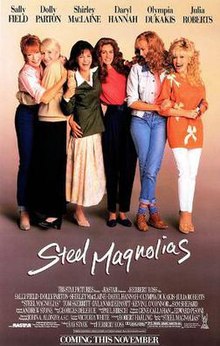
It’s considered a classic now, Steel Magnolias. The play by Robert Haring made a wildly successful transfer to the screen with an all-star cast: Julia Roberts, Sally Field, Olympia Dukakis, Shirley MacLaine, Daryl Hannah.

On the surface, it’s a story of the love between a mother and daughter. But as you watch the film, you can’t help but be struck by the emphasis on friendship.

The women in this film are friends, long-time friends who celebrate and tolerate each other’s imperfections. They aren’t shy about expressing their support or criticism, but it’s always, always, done with love. Maybe you have friends like them. I know I do.

So when Julia Roberts’ character dies, the older women rally around their friend, Sally Field. I’ve included the clip from the cemetery, a scene you’ll no doubt remember because of your inability to watch it without crying yourself.

Her grief and rage are familiar to those of us who have lost someone we love, whether friend or family. But what I’m always struck by are her friends.

They watch her standing alone near her daughter’s grave, and approach her. They try, mostly unsuccessfully, to make her feel better, to lessen her loss. But they know they can’t. You can see it on their faces. They can’t make the grief go away. They can’t justify her loss. They can’t change anything, though they’d move heaven and earth to do so.

They are helpless. Watch the scene: they are helpless in the face of so much pain. So they do what friends always do: they wait. They let her scream and cry and pace and curse. And they wait. And then, improbably, they make her laugh.

What did they accomplish, other than – temporarily – relieving the tension? Her daughter was still dead, her grandson growing up now without a mother. Nothing changed. Except for one thing.
She was reminded that she wasn’t alone. For me, the most devastating part of grief is feeling you’re alone, that no one else understands – or cares about – what you’re going through. 

That’s where friends make all the difference, even when they themselves are grieving. They can help their friend by understanding, not judging; by listening, not lecturing; by crying and on occasion, laughing.

“I didn’t know what to say” is a common excuse for doing nothing to help a grieving person. Well, guess what? You don’t have to say a damn thing. Just show up. Just listen. Because like Sally Field’s friends, you’ll make all the difference in the world.


Steel Magnolias


Tuesday, July 29, 2014

Friend Grief and Reunions

Our 2010 reunion
It’s reunion season.

I graduated from Nerinx Hall, a Catholic girls school run by the ever-progressive Sisters of Loretto in St. Louis. Since our 20th reunion, we’ve met every five years.

We’ve met in the school cafeteria, a country club, and the home of one of our classmates. Sometimes we’ve had one event, sometimes two over a weekend. Certain traditions are included at each reunion.

First, no men. We made that mistake at the five year reunion (actually held a year late) and decided it was too much trouble to entertain husbands or boyfriends. We have a lot more fun when it’s just us.

Second, before we meet for dinner or brunch, we have a tour of the school to see the wonderful improvements and bemoan the old days of manual typewriters rather than iPads.

And third, we start with Mass in the chapel at school. We used to have a priest celebrate it, but that became problematic. Now we have our own service, our way. The music changes, the readings change, but one thing is constant.

During the offertory, a rose is presented in memory of each girl from our class who has died, starting with the one who died while we were still in school. The causes of death – cancer, automobile accidents, suicide, 9/11 – are rarely discussed. But the girls themselves are remembered.

There have been times when we’ve gathered to plan a reunion when no one had died since the previous one. That will probably not happen again, though as far as I know, a year away from our next one, there’s no new rose to add.

Sometimes the deaths have been well-known to the class. Sometimes we’ve been surprised because we’d lost touch with someone. But as we age, we know that there will be more.

Maybe you’re one of those heading out of state or just across town to reconnect with old friends. Your focus may be on impressing people or just hoping to not embarrass yourself.

But at most every gathering – no matter the length of time – you will be confronted with the knowledge that not everyone is there. The girl whose locker was next to yours, the one who passed notes to you in World History, the one with the curliest hair - one or more of them have died.

Maybe you were close friends. Maybe you were in different cliques and just never made the effort to get to know each other. It doesn’t matter.

At some point during your reunion, you’ll look around. You’ll marvel that everyone got older except you. And then you’ll remember those who did not make it to their 20th birthday, much less their 50th. They were part of you, part of growing up, even if they’re gone.

So take a minute like we do. Recite their names, or include their pictures in the reunion program. Share a story.

And include all your classmates in your reunion.

Friday, March 8, 2013

Dead Friends Who Still Talk To You

Delle Chatman
Four of us sat in the front of St. Gertrude’s Church one November morning. It was a year after our friend Delle Chatman’s death.

Kim, Rina, Jeannie and I originally met Delle because our children attended Sacred Heart Schools on Sheridan Road in Chicago. Now the four of us decided to remember her with Mass followed by red velvet cupcakes at Metropolis, the coffee house where we all hung out.

In November, St. Gert’s puts up an ofrenda: a small, temporary altar displaying photos of parishioners who died during the previous year. Prominent on the table, just to the side of the main altar, was a joyous photo of Delle and her daughter, dressed in traditional African robes, dancing. It was definitely a symbol of how we wanted to remember her: happy and healthy.

Also on the table was a candle burning unobtrusively. But just as Father Dom came out on the altar to begin the mass, the flame shot up and caught the linens on fire.

“Oh, shit,” were the first words out of my mouth, not the preferred response from the front row in a church. Rina was on her feet first, and the flame was quickly extinguished. No harm was done to the memorabilia, and Father Dom missed the drama because it was out of his line of vision. But it was a challenge to not laugh out loud. There was no doubt in our minds who was behind it.

A month before she died, Delle announced that she was discontinuing her cancer treatment. Her body just couldn’t take any more. That email unleashed a flood of emotional responses, friends from all over the country pouring out their love for her.

“I’m not dead yet. Save it for the funeral – I’ll be there,” was her embarrassed response. She was indeed.

Her memorial service was, as my husband called it “the shortest two hours I’ve ever spent in church.” No one wanted to leave. We needed to lean on each other.

Delle’s daughter, “the remarkable Ramona”, was eleven. She had told her mother she wanted to sing at the service “so everyone will know I’m all right”.

We were sitting directly behind the family, close to the front. I remember when Ramona stood and walked over to the microphone. When she got there, a shaft of light broke through one of the stained glass windows and shined on Ramona. There was a gasp from people around us. Not everyone could see it; it depended on where you were sitting. But after my initial shock, I just shook my head. “That was pretty melodramatic, even for you,” I thought to myself.

Those were two of the times I’ve felt Delle’s presence. There have been others, and I hear her voice now and then.

Maybe you hear voices, too. Maybe you just walk into a room and feel the presence of your friend. Wishful thinking? I guess that’s possible. But I like to think our friends are always with us, stalking us long after they’re gone.


Friday, May 11, 2012

Calling All Girlfriends!


vintagesusie&wings.com

I started out writing my book believing I knew one thing for sure: I’d have no trouble finding women to talk about grieving a friend.

And that was true. But, as I’ve written here before, the men surprised me with their willingness not just to talk: sometimes they offered to talk, unsolicited. As a result, I currently have an imbalance of male/female stories in my book.

Now I’m looking for more women to interview. I’m particularly looking for women who have grieved a friend (male or female) with the following special circumstances:

            You’re a member of a religious community

            You’re a first responder or military

You channeled your grief into action by supporting a cause that either helped your friend or was otherwise important to them.

You experienced the deaths of several friends within a short period of time.

            You used your grief as a catalyst to make changes in your personal or professional life.


Sister of Loretto
If you’re willing to share your story, please email me at victorianoe@friendgrief.com. We can set up an interview online, by phone, or in person. You also have the option of answering a series of questions and emailing them to me.

By doing so, you agree to allow me to use your story in my book, but you always have the option of remaining anonymous.

Don’t want to, but know someone who might? Feel free to pass along this post.

I’m trying to finish interviews by July 1, so the sooner I hear from you, the better.

And know that I’m deeply grateful for your willingness to share your stories with me. Together we can help others who are grieving the deaths of their friends.


Monday, May 7, 2012

"Lots of Candles, Plenty of Cake"

I was fortunate to be in the audience for the Chicago Tribune’s sold out Printers Row Live event on Friday evening, a conversation with author Anna Quindlen.  

Her new book, Lots of Candles, Plenty of Cake, is a thoroughly enjoyable reflection as she reaches a milestone birthday this summer: sixty.

In the interest of full disclosure, I’ve been a fan of Quindlen’s for many years, and not just because we share a birthday. Her writings have spoken to a generation of women whose lives were defined by choices our mothers never enjoyed: choices that complicated as well as simplified our lives.

In her latest book, Quindlen takes time to pause, to look at where she’s come from and where she’s going. Her conversational tone – reminiscent of those times with friends when we dissect our lives and solve the problems of the world – makes this a quick, but thoughtful read.

She addresses many of her trademark topics: women in the workplace, parenting, growing up Catholic, marriage. But, cognizant of moving from what one author called ‘moving from middle age to Renaissance’, she considers her future, and what aging means to a generation of women who are living decades longer than their parents.

The parts of her book that resonated the most with me right now were those that addressed aging and friendships.

“One of the most important parts of tending our friendships is working our way, over time, into the kind of friendships that can support cataclysm, friendships that are able to move from the office or the playground to hospital rooms and funeral homes…On the one side are the difficult and demanding events to come, the losses, the illnesses, the deaths. You can see them out on the horizon like a great wave, its whitecaps approaching. But on the other hand is a levee that protects us, that of the women we can call anytime, day or night, to say, ‘I’m drowning here.’”

Her observations on aging – not just the physical changes – will probably resonate with you, no matter your age:

            “The thing about old friends is not that they love you, but that they know you.”

You know how it is: friends from the old neighborhood, from high school, from college or your first job. They remember things…they remember you, and who you were at a particular time in your life. The longer the friendship, the more “you’s” they remember.

            “And then one of them is gone, and you’ve lost a chunk of yourself.”

Deep into her book, Quindlen quotes memoirist Carolyn Heilbrun.

“Since we do not wish to die, surely we must have wished to grow old.” – The Last Gift of Time

I thought that was a great way to describe a lot of us Baby Boomers. We have believed most of our lives that we are the first generation to experience…almost everything. Now unable to deny that we are no longer young, we are forced – kicking and screaming, it seems – to admit we are getting older. In spite of our best efforts, we are not immortal.

There’s no doubt that we Boomers are unwilling to accept a traditional, sedentary old age. We are determined, as always, to reinvent every stage of our lives.

We can’t put off the inevitable, at least not forever. But we can enrich our lives now – no matter how old we are – by treasuring and nurturing and enjoying our friendships.

If you’re a woman of a certain age – or even if you just want to understand women of a certain age – you’ll enjoy Lots of Candles, Plenty of Cake.

And be sure to share your cake with friends.


Check out Anna Quindlen to order this or any of her other books, and learn more about upcoming appearance.


Friday, May 4, 2012

"Love is in the Details"

E. Jason Wambsgans, Chicasgo Tribune
The front page of the Chicago Tribune is generally reserved for hard news. And stories that begin “above the fold” are typically national or international in nature.

But the story that began just under the masthead on Thursday, with a series of three photos, was very local. You could say it’s a little story. It has no earth-shattering implications for the economy or national security. It’s a story of friendship and loss, and the friends left behind.

A year ago yesterday, Justyna Palka, an art director at Ogilvy & Mather, was struck and killed by a tour bus as she crossed a busy intersection in downtown Chicago. The bus driver has an extensive criminal record. He tested positive for cocaine and is awaiting trial for aggravated DUI and reckless homicide. Palka was 26 years old.

Born in Poland and raised in Germany, Palka moved to Chicago in 2006 to study at the School of the Art Institute. She excelled at school and strove for perfection. “She couldn’t do anything halfway,’ said Karen Smith, her supervisor at Ogilvy & Mather. But in the months before she died, Palka had begun to focus on living a more balanced life, with an eye to her future.

Within days of her death, Olivia Roszkowska left dogwood and hydrangeas at the corner where her friend died.

“I could not stand people passing by and not knowing what happened there,” Roszkowska said. “I just didn’t want this intersection to be so empty. I didn’t want this intersection to be like nothing happened there.”

At first, the flowers were left on the sidewalk, but they wilted and were swept away. That wasn’t acceptable. She asked permission from Palka’s mother to put up a bouquet, and tied it to the sign post.

When the flowers faded, she replaced them with new ones, eventually with artificial ones that could stand up to Chicago’s unpredictable weather. Even as rain and snow replaced the summer sun, the flowers remained.

She was joined by others, also friends of Palka, who found comfort in scouring craft stores for just the right selection:

“’There’s something therapeutic about picking out the flowers. I almost feel like I’m there with her,’ said Elyse Simpson. ‘I think about how thoughtful she was. How every detail had to be perfect.’”

The selection changed with the seasons: hollyberries for Christmas, orchids in the New Year, red gladiolas for Valentine’s Day

Sometimes other objects were left: a small Santa statue in December and a cross at Easter. But Palka loved flowers, especially tulips, so that’s what her friends brought.

“A year after the accident, friends take comfort in the fact that now, as in every May, the city’s boulevards are bursting with tulips, Palka’s favorite flower. ‘I saw the tulips today while I was driving,’ said Yuridia Trujillo. ‘Every time I see them, I think of her.’

Roszkowska flew to Germany this week for Palka’s memorial, which included the unveiling of a bronze statue.  But first, she stopped at Columbus & Illinois.

“It was 9pm by the time she arrived with an armful of silk orchids and roses. Cars zoomed past as she worked to attach the flowers to the street pole. Sometimes people will stop and talk, but on this night, she was alone.

‘Just that moment of putting the flowers on the corner, it has a very deep meaning for me,’ she said. ‘I think about what happened and how much I miss her as a friend.’”

One of Justyna’s favorite sayings was ‘love is in the details’. It was true for her, and most definitely is for her friends.


Monday, April 16, 2012

Worrying About Your Friends

I don’t know about you, but I’m getting tired of finding out about the deaths of friends. It’s not that I was close to all of them, but they were still a part of my life at some time. So I decided to revisit this post from last spring, because it’s still true.

At the end of the morning roll call on the 80’s hit Hill Street Blues, Phil would always remind his comrades “let’s be careful out there.”
They were cops. They knew every day could be their last.
Not everyone lives that consciously, certainly not when they’re younger.
But the truth of the matter is, the world is a dangerous place. Stuff happens, no matter where you live.
We can eat healthy foods, exercise every day, do all the things that are supposed to “guarantee” a long life and still not reach that goal.
This photo is from my 40th high school reunion. Each rose represents one girl from my class of 122 who died; there are 9. One died our senior year, the most recent, two years ago.
As we age, we lose more and more friends. It’s just the law of averages, and not unexpected. What we don’t expect are the “before their time” deaths.
We don’t expect to experience a friend’s death before we’re old enough to vote.
We don’t expect to experience a friend’s death before our hair turns grey.
We don’t expect to experience a friend’s death, period.
So when it happens, we can become skittish, paranoid about our remaining friends. We pester them to lose weight, exercise more, or have that mammogram. We probably annoy them beyond words, and they might even tell us to back off.
Too damn bad.
The price of being a friend is that you are loved. And you’ll just have to live with that.


Monday, March 5, 2012

Grieving for a Celebrity “Friend”


Davy Jones
 "Did you hear who died? Because if you didn’t, you need to sit down.”

That was the text I sent to my girlfriend last week. I saw the news on Facebook and Twitter, and when I didn’t hear from Eileen immediately, I realized she must not know what happened.

She responded instantly, asking who it was.

I hesitated. I was the one who called her almost 30 years ago to tell her that one of her very favorite actors had died. This was another sudden death.

“Jones.”

“Jones” was Davy Jones of the Monkees, who died of a heart attack last week at the age of 66.

In the interest of full disclosure, in high school we (and a few other girls, too) wrote what now would be called “fan fiction”: stories about celebrities. The details varied, but the plots inevitably included our celebrity crushes falling madly in love with us. Our writing was enthusiastic, but not necessarily good. We wrote in spiral notebooks, with little or no editing.

As long as the nuns didn’t ask to look at the notebooks, we just looked like we were working really hard. At our lockers, on the stairs in the back of the cafeteria, or possibly during World History lectures, we shared what we’d written the night before. The obsession eased over time.

But we’ve kept the notebooks all these years. Some of the stories involved the Monkees.

It was shocking news, and our response to it was probably typical of people our age. Eileen and I had a 3-way phone call with our other girl friend, where we reminisced and then made plans for getting together when Annie’s son gets married this summer.

I’ve written before about how odd it seems for people to get upset when a celebrity – who we probably have never met – dies. But that person – like our friends – represents us at a certain age: our hopes, our dreams, and often times our insecurities.

The celebrities we had crushes on told us a lot – often in retrospect – about our taste in music, theatre and men in general. We tended, as we matured, to not admit to some of those crushes.

Davy Jones’ influence, by virtue of those spiral notebooks shared every morning at school like new installments of a Dickens serial, was a little different. Eileen gives him full credit in an article she wrote on Novelists Inc for moving her future writing career to the next level:

“So, thank you, Davy. Not just for being the nonthreatening fantasy that helped ease my way into the dangerous waters of my teenage years, or for being the kind of person who never tarnished my image of you as a sweet, funny, all-around nice guy. But for showing me what would make me happiest in my life, and helping me do it. I, for one, won’t ever forget you.”


To read Eileen’s complete article: "What Davy Jones Had To Do With My Career"

To read more about Eileen’s award-winning writing career after the Monkees: Eileen Dreyer